




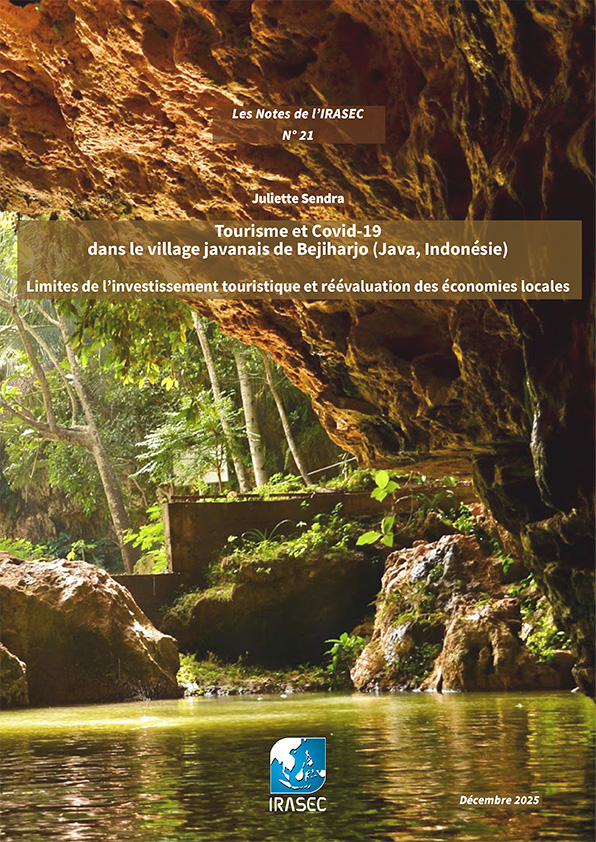
Tourisme and Covid-19 dans le village javanais de Bejiharjo (Java, Indonésie)
New IRASEC Discussion Paper
Article
 Juliette SENDRA
IRASEC, Bangkok
december 2025, 29 p.
 Text in French
This article is a reflection on tourism in Asia in light of the consequences of the Covid-19 pandemic, based on a case study of the Javanese village of Bejiharjo. The village is located in the Gunung Kidul region (“southern mountains”), which was classified as a geopark by UNESCO in 2012. The Indonesian government took advantage of this ranking to boost tourism in an effort to combat the economic stagnation and rural exodus that had been ongoing since the 1970s. However, in this region, which had long remained peripheral, the speed and brutality with which tourism developed over the last ten years disrupted the villagers’ way of life.
In 2020, during the Covid-19 pandemic, the sudden halt to this activity—which had become dominant in Bejiharjo—reversed the momentum that had been built up : the social category of young people that seemed to be emerging in favor of tourism found itself at an impasse. Government investment in mass tourism (both domestic and international) appears to be under scrutiny at both the institutional and village levels. Furthermore, with the halt in tourist flows, the dual social and environmental deterioration caused by overtourism has become more apparent.
Agricultural activity and circular rural economies have once again become indispensable. Former political and economic leaders embodying traditional authority have been reinstated, and discourse denouncing the loss of vernacular knowledge and practices has gained visibility in the village social sphere.
This geopark illustrates the new challenges posed by Indonesian tourism recovery systems in terms of environmental, social, and economic sustainability.
Read the Discussion Paper :

Juliette SENDRA holds a PhD in social anthropology and is a research associate at the Institute for Asian Studies (IrAsia) at the University of Aix-Marseille. Her research focuses on sociopolitical dynamics in rural areas of Java (Indonesia), examining the transmission of local knowledge, ritual initiation, and relationships with the environment in the context of recent processes of heritage preservation and tourism development.
13 January 2026


