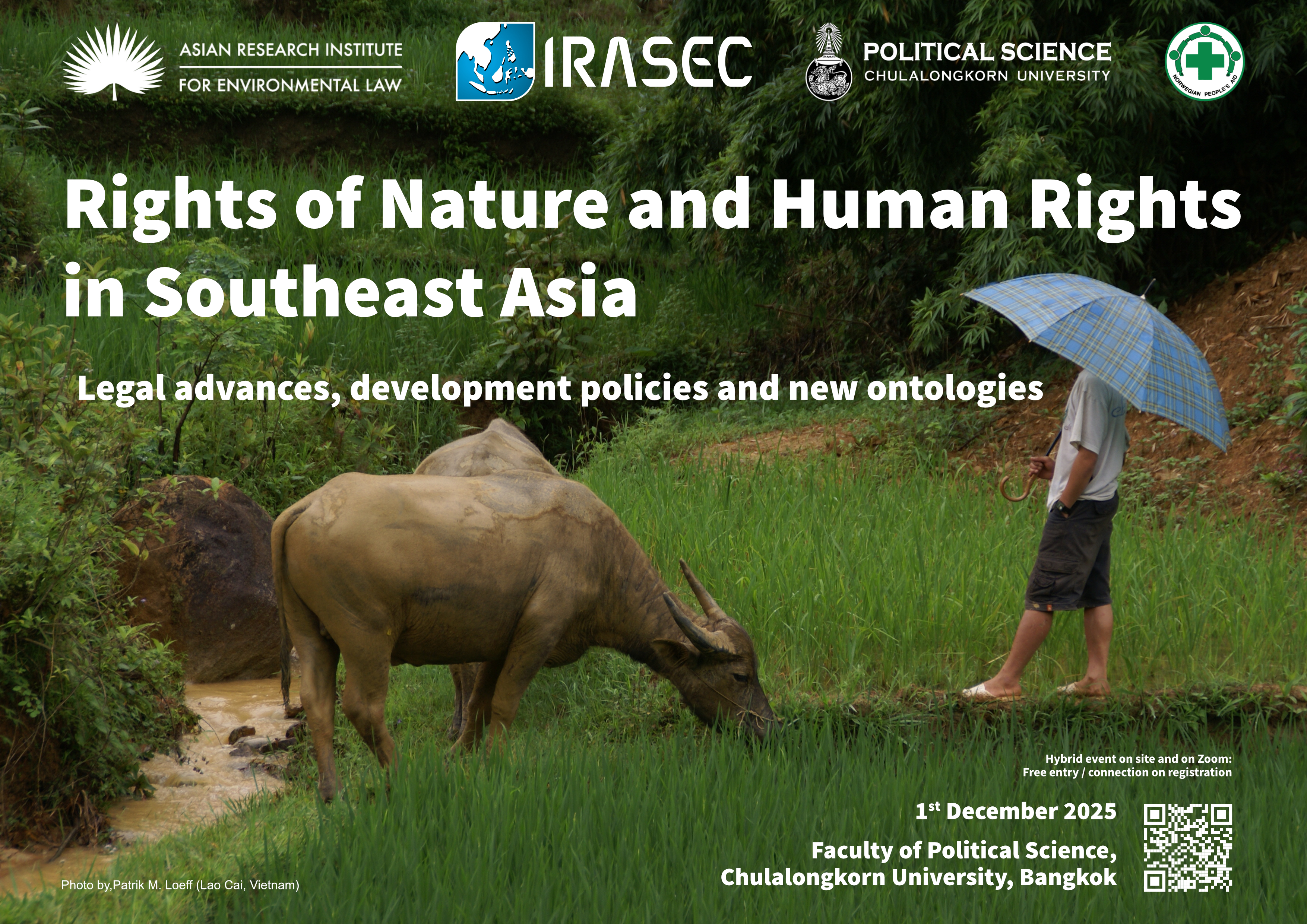


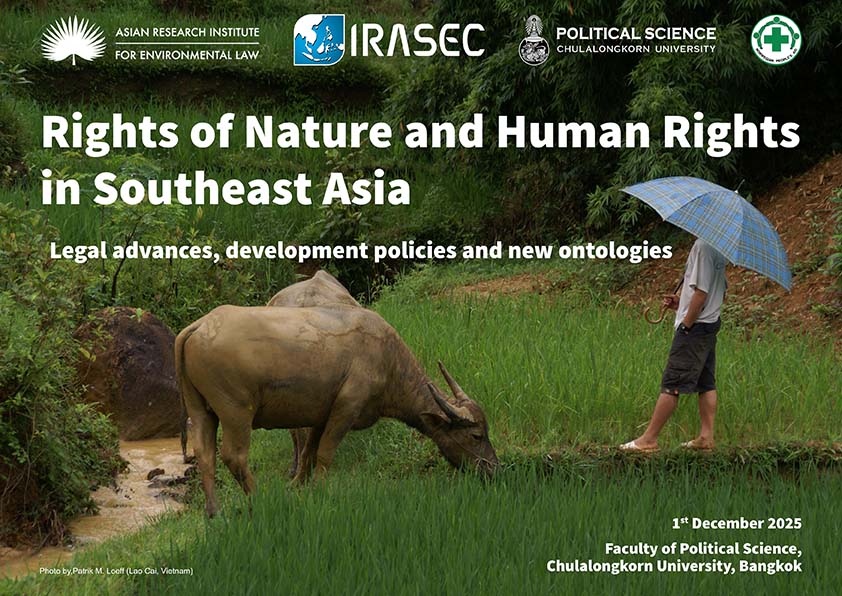
Rights of Nature and Human Rights in Southeast Asia
Legal advances, development policies and new ontologies
Conférence
 Monday, 1st December 2025, from 9am to 5pm
Alumni Association Meeting Room, 12th floor
Faculty of Political Science, Chulalongkorn University
Coorganized by the Research Institute on Contemporary Southeast Asia (IRASEC), the Faculty of Political Science, Chulalongkorn University, and the Asian Research Institute for Environmental Law (ARIEL), with the support of Norwegian People’s Aid.
 Watch the video of the morning session
Watch the video of the afternoon session
Our planet and humanity are confronting multiple, interconnected ecological crises, from climate change and biodiversity loss to rising levels of pollution. Despite the proliferation of policies, laws, directives, and international treaties intended to protect the environment, the planet’s health continues to decline. In this context of faltering environmental governance, one emerging proposal is to embrace a new legal paradigm : the recognition of the rights of nature.
This approach challenges the dominant, human-centered view that treats nature primarily as an object, rooted in anthropocentric assumptions of a separation between humans and the rest of the natural world. Instead, the rights of nature movement advances an alternative perspective : one that sees the natural world as an interconnected system of diverse, interdependent forms of life, encompassing the biosphere in its entirety—both human and non-human.
In light of recent progress in debates and decision-making aimed at bringing human rights and the rights of nature closer together, Southeast Asia has witnessed the emergence of several initiatives. While the formal recognition of the “rights of nature” has not yet taken shape at the regional level, multilateral dialogues (ASEAN, OHCHR/ESCAP) are increasingly opening up to these issues. In this respect, the ASEAN Declaration on the Right to a Safe, Clean, Healthy, and Sustainable Environment (ADER), adopted at the 47th ASEAN Summit in Kuala Lumpur in October 2025, marks a historic step in integrating environmental rights into ASEAN’s human rights framework.
Nevertheless, civil society organizations have voiced serious concerns about the drafting process, citing short public input periods, limited translation, and minimal consultation. Indigenous representation is particularly lacking, despite references to the UN Declaration on the Rights of Indigenous Peoples (UNDRIP). Also, progress toward formal recognition of the Rights of Nature remains uneven and slowed by institutional inertia and limited inclusivity. Sustained pressure, reform, and meaningful participation—especially from indigenous and grassroots voices—will be essential to transform current momentum into lasting rights recognition.
Challenges thus remain, particularly regarding the drafting of texts and their legal force. Potential advances include stronger recognition of Environmental Human Rights Defenders (EHRDs), the establishment of binding mechanisms, and enhanced accountability. These legal and governance efforts can be further enriched by political, geographical, and anthropological perspectives. Against this backdrop, this conference will bring together governance actors, civil society representatives and researchers, to share recent progress and explore future challenges for the development of legislative frameworks linking nature rights and human rights.
Conference Approach and Objectives
This conference will focus on the triptych of conventional human rights, the right to a healthy environment, and the rights of nature—analyzing their interdependence and exploring how development actors can approach these issues from an ecocentric perspective.
The conference will first examine how development policies intersect with the incorporation of the rights of nature into national environmental regulations. Particular attention will be given to the challenges of articulating human rights and the rights of nature in Southeast Asia, especially the “inter-legalities” arising from the coexistence of diverse normative systems and the potential conflicts between these categories of rights. Such conflicts may be analyzed both at a theoretical and normative level—for instance, through questions of hierarchy of norms—and at a practical level, notably in relation to territorial dynamics such as green colonialism or land grabbing, often at the expense of the customary or informal rights of local populations.
Another focus of the conference will explore how the rights of nature are defined and constructed, the actors driving this process, and the legal strategies employed—whether through case law, regulation, or constitutional reform. Particular attention will be given to territorial contexts, especially those marked by conflict, where narratives and power dynamics between actors crystallize into the legal recognition of new rights for natural entities.
Finally, a third axis will address the epistemological generativity of the rights of nature by examining the personality and identity of their objects. The discussions will ask : to what extent does granting rights to a natural entity foster the creation of new ecosystemic, landscape, territorial, and cartographic assemblages, thereby contributing to an ontological transformation of the entity itself ?
12 novembre 2025